The words “not guilty” rang like an explosion through my being. The English judicial system had been ignited with the force of a love so raw and fundamental that the crucible of its transformation now howled through me. Everything fell away and I dropped to the ground as I joined the force of a collective consciousness and my phone sang with people across the globe recognising the magnitude of this moment. Together we had felt the power of soil, guts and soul merging within the confluence of divine and man-made law. Together we had felt the power of love protecting life through life. And together, just for a moment, we had changed the world.
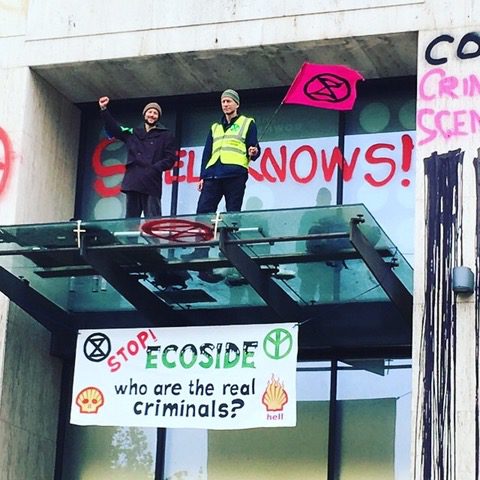
Two years earlier my partner, Sid, stood on the balcony over the entrance to the Shell Headquarters in London for twenty four hours whilst others locked themselves onto the building and smashed windows and others spray painted ‘make ecocide law’ and ‘Shell knew’. It was the beginning of the first major Extinction Rebellion protest where thousands of people occupied key sites across London for almost two weeks. The movement turned global and as a result the UK government declared a climate emergency and ecocide became a household word.
I asked Sid to explain what had led him to making such action:
“I spent years protesting in my late teens and early twenties, everything from Nike sweat labour, to Palestinian rights and anti GMO crops. But it was the protest against the Iraq war in 2003 which broke me: the largest protest event in human history and still our governments went to war. I was so disillusioned by the greed and corruption that I saw governing our world that I decided to leave the country.
After India I spent nine years in Canada and America studying permaculture and sustainable buildings techniques. Through permaculture I found a system that integrated the needs of both people and the earth and that created wealth without it being at the expense of either. Permaculture teaches us how to interact with the world with an awareness that is profoundly respectful and highly conscious of its causes and effects. It looks to nature for its design, works in accordance with the natural laws and implements them using modern as well as ancient technology.
My studies gave me a sense of peace and clarity: I felt hopeful as I realised that we as a western culture do have the means to evolve into a place of alignment with nature and that the systems and knowledge are available to us. Permaculture shows that aligning ourselves with the movements of nature allows designs that work in harmony with the needs of everyone to flow through you. It became my form of activism to create designs that work for the benefit of all, creating concrete free foundations systems from glass waste streams and reciprocal growing systems.
A design I particularly enjoyed creating was an urban vegetable garden that I designed on an acre of toxic land in Berkley, California. Previously a printing press, the land was full of heavy metals and gophers and was only available for a few years before a construction site was taking it over. I designed a fully transportable growing system from the waste stream of hardwood pallets from the city. With others I set up a vermiculture system that fed on the local horse manure, taught workshops on food security and gave all the food away to people who needed it. We created community events to fundraise and we lived in balance while both planet and humans benefitted.
Back in England I moved to Stroud and found myself gravitating towards the founders of XR who lived in the same town. When I heard about the plans for the Shell action I felt a resounding ‘yes’ throughout my body: here was a design for something that benefited both Shell and the earth. Shell has a fundamental desire to be of service to the world, to be part of the progressive movement of life that also sustains and harmonises life. Shell makes seventeen billion pounds profit each year, so the damage we were going to cause would be the equivalent of three pence for an average UK wage. In return Shell received a reminder that its goods and service were no longer in alignment with the best vision for our future and that it has the capacity to change. Being the first day of the XR uprising it held the potential to join a much larger collective voice and it would also bring the meeting place of our current legal system, and the natural ecosystems that need protecting by that law, to the attention of both the media and the courts. But perhaps most importantly the moment presented itself, and I felt called to respond. It felt like my duty and purpose to respond to what was before me in the most heartfelt and sincere way possible.”
When the day came, Sid and what would become his co-defendants mixed natural chalk paint in their hostel before making their way to the Shell Headquarters. Arriving at the site, David and Senan distracted the security guards while Sid and Ian started climbing up the scaffolding to the balcony above the front entrance. Sid described the experience for me:
“I was attacked twice on the way up by builders. The first time I was in a position where the builder was able to repeatedly kick me in the leg. I stared into the eyes of the builder as he did it, in my being I gave him full permission to kick me as much as he wanted. I held him with love and compassion as he did what he felt was right. I think some part of him could feel the depth with which I wasn’t resisting him and so he soon stopped and left me alone.
I then got up to the next level and another builder was able to hurt me with with much more force as he tried to pull me down. He was on the verge of seriously damaging me so I turned and looked at him in the eyes and said “I am going to reach the canopy and nothing is going to stop me. I am doing this for us all, for our children and their future and if you hurt me in the process you are going to be the one who suffers”. I felt so clear and calm about my purpose I think he could feel it and he also let me go and I continued on my way.”
When Sid told me about his experience I recognised the quality of saṁkalpa, a very special word in the Sanskrit language which means a resolution formed in the heart. But it also means much more than this; it holds within it the resonance of the earth. saṁkalpa is one of only a handful of words that are generated from the root klṛp, which is the only root generated from the letter lṛ. lṛ is one of the sixteen divine mothers of the Sanskrit language and lṝ which is its long form is known as the ‘Mother of the Gods’; a direct expression of the earth element. Sinking into the etymological depths of saṁkalpa we find mother earth. We also find a reflection of the movement we make as human beings who are fed, sustained and nourished by the gifts of the earth sinking through our resolutions, desires and impulses: eventually we find mother earth.
Listening carefully to these intentions and desires, we notice the difference between those that we choose to implement and those that seem to appear within us. Imposing rules and ideas based on ideas about what we think should be done, or formed within an isolated sense of self tend to fall quickly by the wayside. It is the ones that reveal themselves, rising from within, that hold a power and resonance that can move mountains. Lives can change in a moment and material obstacles that felt insurmountable can miraculously move aside.
Looking again at the etymology of saṁkalpa we find deeper levels of the harmony between its structure and our experience. The root klṛp, means sāmarthye: ‘in having the capacity or potency to fulfil something’ and ‘sam’ means ‘bringing together into a unified force’. So ‘saṁkalpa’ brings together in one unified force the capacity for something to be fulfilled. through us. The implied causative sense found in the root klṛp means that it is the depth of the resolution or saṁkalpa itself that holds the capacity for its fulfilment.
Fulfilment here does not mean that we will get exactly what we want if you believe it strongly enough. Each seed we plant holds a unique capacity for growth that is deeply interconnected to everything around it; we fulfil a capacity required in relation to the all. Different movements and impulses will move through us at different points in our life, dependent on everything that has gone before and that will come afterwards. The will of the earth is already in operation; we can of course fight against it but we are fulfilled when we feel whole, connected and free and is found when we allow the impulses of life to play through us exactly as they are meant to do.
We can’t make a saṁkalpa reveal itself, but we can become aware that sticking to intentions that don’t have a depth of concordance prevent us from hearing. It is when we become still that we move into closer relation with the undercurrent that directs our life: here we can listen to the whispers, as if blown into our fertile land by the wind. Offering no explanations and no guarantees, these are the saṁkalpa, the very substance of our being singing into expression.
Two years after the action Sid and five other defendants decided to self represent in a trial that would last two weeks before a jury. Sid’s co-defendants couldn’t fathom Sid’s belief: “Shell would have given me permission to do this”, and asked him not to go ahead with his plea as it may affect the whole case. Their reasons for doing the action were to do with ‘necessity’ and ‘duress’: the action was proportionate and necessary to bring attention to life being lost across the globe due to fossil fuel consumption with the hope that it would bring about change. They also felt under duress of circumstance as they faced the imminent collapse of our ecosystem and there was no choice but to raise the alarm in the only way they knew how. They knew that this argument would not stand up in law and that they had no legal defence: their only intention was to give voice in the truest way possible to the movements of conscience that had impelled them to act.
But as Sid connected again and again with the statement “Shell would have given me permission” all he found was truth: he knew he had to say it in the court room. Meanwhile I was trying to come to terms with the effects that this action had on our young family as the high likelihood of an £18,000 fine loomed over us. On the day that Sid went to court, I managed to summarise something of what this process was like for me:
T h a n k Y o u
This week my partner, and five others stand before a jury for their action at the Shell headquarters during the XR protests two years ago. XR haven’t always got things right. They gave incorrect legal advice to us and said they had money to pay for fines when it turns out they don’t. My family has sacrificed a period of sanity as part of this process and things got bad enough to force me to go deeper.
I remembered the natural and intuitive care for the pains of the earth that I used to feel as a child. I would fast to collect money for the Amazon rainforest and would walk through the small patches of waste land in my town picking up litter.
And then as a young adult the mess of my personal psyche became too much too bear and I dedicated fifteen years of my life to finding a resolution. Through meditation and mantra I felt the harmony of the natural laws of our universe maintaining everything in a perfect flow and harmony. It was a relief to realise that this domain of being existed beneath all the vicissitudes of life and it was easy to stay here.
But I am also part of the responsivity of this harmony, and the movements of life called me further. Our family found ourselves in the gap: the meeting point between the legal system of our land and the heartbreaking atrocities committed against this land. And over the last four weeks I have felt the power of this gap rising into our collective consciousness as my attachment to my sense of the personal has been eroded by the continual stream of loving service that we have received.
XR continue to make mistakes, they have alienated many and angered some. And they have galvanised a shared love for the spirit of life that sustains us all, offering us a chance to experience a heartfelt and full participation of life; a chance to make conscious an aspect of that which we may already deeply feel.
The goal of yoga is ‘kaivalyam’, ‘in service to the one energy of life’. During these weeks I have experienced the force of a collective joining together in service to something bigger than the self and through it I have felt a joining with the fundamental movement of life. As I have been held, I have allowed myself to feel the unending vulnerabilities of the consequences of this action, and through it I have been broken open.
And so I thank you XR for exploring the gap, for coming together and making mistakes, and for creating an opportunity for us to feel how the movement of service can play out through our uniqueness.
Thank you to all the people who don’t know us and have sent heartfelt cards. Thank you for the delicious meals that have been brought to our door. Thank you to those who have held me and the vast nuance of this subject, and for the connections it has brought. Thank you to the teams of people that have come together; wellbeing, research, media, and finance. There are more people that I could have possibly imagined who have stepped forward with a shared love for this earth.
And so here I find myself broken open.
in the gap
In service.
T h a n k Y o u
Sid stood unshaken in his truth, and made history to become the first person to use a defence of belief of permission for activism, and he made further history by becoming the first person to have this defence passed by the judge as being permissible in law: Sid had a legal defence.
The lṝ sings the earth into being; bringing our tongue to rest behind the top teeth we find its resonance within and so we join its song. But it has many ways of making itself known to us; a knowing that rises from within, a recognition as we catch someone’s eye or see the way someone moves in the world. In the six weeks leading up to the trial Sid formed a love affair with the mother of the Gods as he kept returning to the resonance he had heard within. He made a fearless inventory of what was standing in his way as he wrote and re-wrote his speech and dedicated himself to finding the words that could carry most authentically the frequency of his deepest held saṁkalpa, of the lṝ that lay within, the mother of the Gods; earth herself coursing through his being.
Skeena Rathor who was sitting in the public gallery said the following after hearing Sid’s speech:
“When Sid started speaking it felt as though there was electricity pulsing through the court room: the resonance of his words was so palpable I literally felt like I could touch them. They felt like they were carrying such a strong feminine mothering principle and seeing that in a man is so powerful. My heart became like water seeping through my body and reached all the way to my toes. The love that he was communicating felt so expansive that it filled the court room.”
When speaking to Sid about his experience he said the following:
“I repeatedly gave thanks as I listened to the others and waited for my turn to speak. I had heard a call from deep within me and I had followed it for which I was deeply grateful. Whatever eventuality the voices in my head tried to churn over I drowned them out with gratitude. I kept finding that within me that I knew was true. It was a physical thing, its hard to explain how you know, but you just know when you get a full body, full energy, yes to something.
I kept checking in with myself, is this my truth? I again and again made that enquiry so that I knew that when the time came and I was standing under oath before a jury I could say it without attachment. I had to be detached to the outcome and yet the words rang so true for me, that I choked up many times as I gave my speech. But I didn’t let me overwhelm me because I had a job to do and I had to find the strength to keep speaking about it, and I found that strength in love. I spent years letting the horrors that have committed by Shell into me, and to my surprise when fully let go of the resistance I found love. I found the life force that exists beneath, that connects us, and here I found true power.”
Skeena continued:
“He talked about real experiences and I felt such a wholeness of his story, such an embodied story. He was able to speak about relationships in such a congruent, genuine, authentic and loving way. He was talking about how his body and heart had felt and it was captivating. I cried three times listening to Sid, and many members of the jury were also tears. There was a point when there was hardly a dry eye left in the court room. It was when he touched on a truth that felt so poignant, so deeply true that it felt like a bold of lightening was being channelled through the room. He pointed to the Shell employees own relationships to the earth, to their life and to their families and said that they wouldn’t want to be in an organisation that was doing harm. No-one in their right mind would want to damage that which sustains us; they, like us are imprisoned within a system that is destroying us. What I heard was that we are all imprisoned and somehow we’ve got to break this cage and set ourselves free. Sid’s action was his part in breaking the shackles free.”
Sid and his co-defendants celebrated the court case the day before the verdict was given. Over a period of two years they had been on a journey of mammoth proportions; they had acted in accordance with something that can’t be captured in the law books and had found the edge between their experience and the law as they let go of all hopes and expectations and found that the only way was in; back in to the call. They placed themselves in harmony with the call and they brought it into the court room. And despite having their personal freedom on the line, they did not turn their backs on that call. In their honouring they now celebrated their freedom.
And so as we approach the sounds of Sanskrit the principle of saṁkalpa asks us to look at our intentions for doing so. It may be that we want to improve our spiritual understanding so that we can be the best possible version of ourselves, or a better teacher; or we may want a new way of looking at things so that we can have a more fulfilling experience of life. All of these are some more or less sophisticated form of: ‘how do I change what I am feeling now, into an imagined form of how I think I could be feeling or operating in a better way in the world’? This is another way of trying to escape from, or negate our current experience.
This mode of striving for self-improvement is a dynamic that is commonplace in western culture and is encouraged by the very structure of our society: we are exhorted to evaluate ourselves, justify our thoughts and measure success in terms of material gain. So we set into motion a dynamic that constantly pulls us into the future into an imagined possible version of ourselves, which also pulls us away from what is happening for us right now.
Of course there are a vast number of effective disciplines and therapies which are able to ease to a lesser or greater extent our physical and psychological issues. But none of them ever quite succeed at giving us the totally clean and continuously shining being that we subconsciously believe is possible to achieve. We believe that if we try just a little harder, or get a little bit better at doing things, or find just the right therapist or technique, then the story of our lives will eventually come to the satisfactory conclusion we are hoping for.
If we remain stuck in this domain of motivation and never see the futility of our self-improvement programme, we may be limited in what we are able to receive from our interaction with a spiritual discipline, because we keep residing in the realm of requiring observable achievements and fulfilling perceived goals. If instead we look a little deeper and ask ourselves with sincere integrity: “what do I truly want from this interaction?”, we may find that answers start to appear from somewhere other than our thinking mind. As we let go of an expectation of ‘spiritual’ answers, we may find ourselves arriving in a sincere place of “I don’t know.”
“I don’t know” said with true acceptance as opposed to being said while wanting and searching to know can feel like a palpable relief as we let go of the need to articulate, explain and justify our motivations. It can also feel uncomfortable as this is not a place where we are often encouraged to rest; rather, a feeling of inadequacy can move us toward filling ourselves with knowing to cover up our unknowing.
Whether we find a place of unknowing within us or not, finding the deepest and most true impulse within will direct the level to which we are able to access both the Sanskrit tradition and the fullness of every moment: just as the blossom on the trees is dependent on the type of seed we sow, so the blossom of our spiritual endeavour will be dependent on the seed within, to which we are consciously connected.
In the judge’s closing speech he reminded the jury that five of the defendants had no defence in law and that this was a court of law, not a court of morals. And yet, with tears in their eyes, the jury delivered six not guilty verdicts. The jury had not only felt the resonance and power of the words that they had heard, but were moved to find a place within them that operated outside of the legal system; they found the mother of Gods singing through them, calling them too to bring her resonance into form.
Outside the courtroom the jury approached the defendants with tears of gratitude; “thank you” they said. The defendants also moved to tears expressed their gratitude; “thank you” they said. And beneath these thank you’s could be heard the whisper from mother earth herself; “thank you” she said.
And as I fell out of the shower in my scramble to answer the phone and the words “not guilty” first rung in my ears, I was pushed to the bathroom floor with the weight of their meaning as I felt every tear the jury had shed, every tingling of the spine, every moment of defiance in the face of destruction, and every human being who has placed personal repercussions on the line and stood for what they believed in. The plight of the suffragettes, the abolition of slavery, the civil disobedience movements across the globe in the face of multiple injustices: all have have been made by ordinary people listening to a call within and bringing this call before the law of the land. Now the earth herself is calling for the reciprocal nature of relationship to be remembered: honouring the earth by making ecocide a crime in law brings us back into harmony with our land; it brings us back in harmony with ourselves.
Six human beings fearlessly allowed their whole system to feel the truth of the destruction being committed against our earth. Six human beings chose act despite the implications it may have on their personal life. Six human beings looked beneath the destruction and found love; they found the mother of the Gods and they brought her before the law of our land. A jury recognised the power of this love; of an action that was integrated with the greater good. And together, just for a moment, they changed the world.
A chapter from ‘The Sounds of Sanskrit ~ The language of Yoga’ (release date 2022/23) ** sign up below to keep to date with the release **
Work licensed to Lucy Crisfield at Original Wisdom™: Creative Commons Attribution-NonCommercial-ShareAlike 4.0 International License Please share widely and reference source: www.originalwisdom.co.uk
Attribution-NonCommercial-NoDerivatives 4.0 International (CC BY-NC-ND 4.0) (https://creativecommons.org/licenses/by-nc-sa/4.0/)
You are free to:
- Share — copy and redistribute the material in any medium or format with the appropriate credit given.
Under the following terms:
- Attribution — You must give appropriate credit, provide a link to the license, and indicate if changes were made. You may do so in any reasonable manner, but not in any way that suggests the licensor endorses you or your use.
- NonCommercial — You may not use the material for commercial purposes.
- ShareAlike — If you remix, transform, or build upon the material, you must distribute your contributions under the same license as the original.
- No additional restrictions — You may not apply legal terms or technological measures that legally restrict others from doing anything the license permits.